
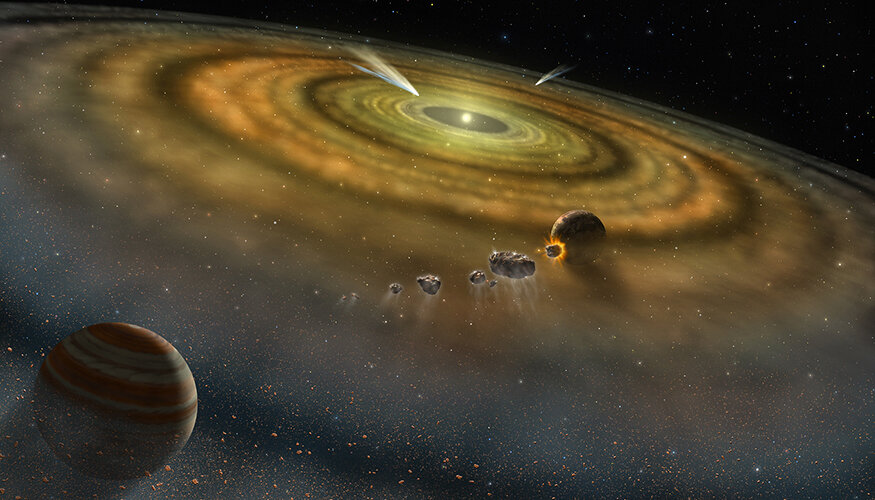
A long time ago—roughly 4.5 billion years—our sun and solar system formed over
the short time span of 200,000 years. That is the conclusion of a group of
Lawrence Livermore National Laboratory (LLNL) scientists after looking at
isotopes of the element molybdenum found on meteorites.
The material that makes up the sun and the rest of the solar system came
from the collapse of a large cloud of gas and dust about 4.5 billion years
ago. By observing other stellar systems that formed similarly to ours,
astronomers estimate that it probably takes about 1-2 million years for the
collapse of a cloud and ignition of a star, but this is the first study that
can provide numbers on our own solar system.
"Previously, the timeframe of formation was not really known for our solar
system," said LLNL cosmochemist Greg Brennecka, lead author of a paper
appearing in Science. "This work shows that this collapse, which led to the
formation of the solar system, happened very quickly, in less than 200,000
years. If we scale this all to a human lifespan, formation of the solar
system would compare to pregnancy lasting about 12 hours instead of nine
months. This was a rapid process."
The oldest dated solids in the solar system are calcium-aluminum-rich
inclusions (CAIs), and these samples provide a direct record of solar system
formation. These micrometer- to centimeter-sized inclusions in meteorites
formed in a high-temperature environment (more than 1,300 Kelvin), probably
near the young sun. They were then transported outward to the region where
carbonaceous chondrite meteorites (and their parent bodies) formed, where
they are found today. The majority of CAIs formed 4.567 billion years ago,
over a period of about 40,000 to 200,000 years.
This is where the LLNL team comes in. The international team measured the
molybdenum (Mo) isotopic and trace element compositions of a variety of CAIs
taken from carbonaceous chondrite meteorites, including Allende, the largest
carbonaceous chondrite found on Earth. Because they found that the distinct
Mo isotopic compositions of CAIs cover the entire range of material that
formed in the protoplanetary disk instead of just a small slice, these
inclusions must have formed within the time span of cloud collapse.
Since the observed time span of stellar accretion (1-2 million years) is
much longer than CAIs took to form, the team was able to pinpoint which
astronomical phase in the solar system's formation was recorded by the
formation of CAIs, and ultimately, how quickly the material that makes up
the solar system accreted.
Reference:
Gregory A. Brennecka et al. Astronomical context of Solar System formation
from molybdenum isotopes in meteorite inclusions, Science (2020). DOI:
10.1126/science.aaz8482
Tags:
Space & Astrophysics