
The countdown is on for the Boeing CST-100 Starliner second Orbital Flight
Test, or OFT-2. Targeted for July 30, the uncrewed flight is scheduled to
lift off from Florida’s Cape Canaveral Space Force Station at 2:53 p.m.
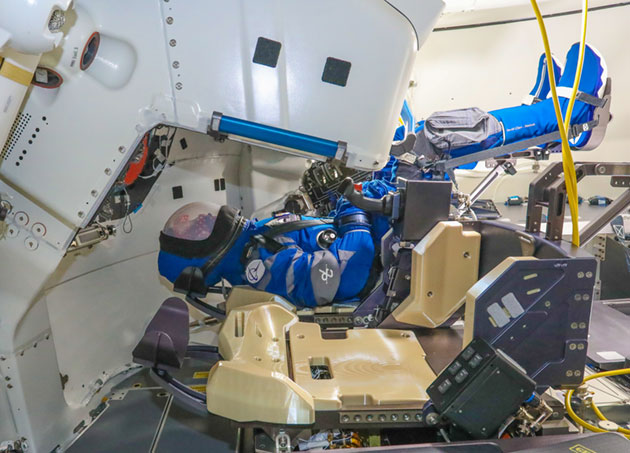
Eastern time — but the capsule won’t be empty. “Rosie the Rocketeer,”
Boeing’s anthropometric test device, will be reclaiming the commander’s seat
for the test flight to and from the International Space Station.
“She is a 180 pound test device in European tan that is meant to represent
the 50th percentile of human dimensions in height and weight,” said Melanie
Weber, the subsystem lead for Crew and Cargo Accommodations on the
Commercial Crew Program. “Rosie’s first flight provided hundreds of data
points about what astronauts will experience during flight, but this time
she’ll help maintain Starliner’s center of gravity during ascent, docking,
undocking and landing.”
“Even the car you drive must maintain its center of gravity or it could
rollover,” Weber said.
For OFT-2, spacecraft data capture ports previously connected to Rosie’s 15
sensors will be used to collect data from sensors placed along the seat
pallet, which is the infrastructure that holds all the crew seats in place.
“While Rosie provided us critical insight into how much force her body
experienced in the commander seat during the first OFT mission, these new
sensors will capture data to characterize the motion of all four crew
seats,” said Dan Niedermaier, crew module chief engineer. “Generally, all
seat locations behave similarly; however, there are small differences that
our engineers want to validate to ensure everyone gets a nice, enjoyable
ride.”
Wearing her Boeing blue spacesuit and red polka dot head scarf, teams
recently strapped Rosie securely into her seat. Rosie the Rocketeer is named
after World War II’s Rosie the Riveter as an ode to the women who have
blazed a trail in aerospace and human spaceflight. During this flight, she
will even be wearing a matching face mask that was hand-sewn by 95-year-old
Mae Krier. Krier is a real-life Rosie who helped build planes in a Boeing
factory in Seattle when she was 17 years old.
“Women in aerospace have made great strides, and hopefully Rosie will
inspire more to enter the industry,” Weber said. “It is absolutely important
to include all people in this field to make sure our services and products
accommodate all people. We only become stronger when we have diverse
perspectives.”
Weber made history as the first woman and first Hispanic to lead operations
at a launch pad during the Starliner’s first Orbital Flight Test. She looks
forward to seeing Rosie again when the spacecraft is moved to the Vertical
Integration Facility to be mated with the ULA Atlas V rocket ahead of OFT-2.
Prior to the move, the Starliner spacecraft, comprising the crew module and
service module, will be loaded onto a weight and center of gravity machine
in the Commercial Crew and Cargo Processing Facility at Kennedy Space Center
to ensure Rosie and the cargo are properly balanced.
“We are all excited to see Rosie in the Starliner again because she
symbolizes our bigger goal of safely and reliably transporting astronauts to
and from the International Space Station,” Weber said.
Following a successful OFT-2 mission, NASA and Boeing are targeting late
2021 for the Crew Flight Test, which will be Starliner’s first flight with
astronauts on board.
Source: Link
Tags:
Space & Astrophysics