
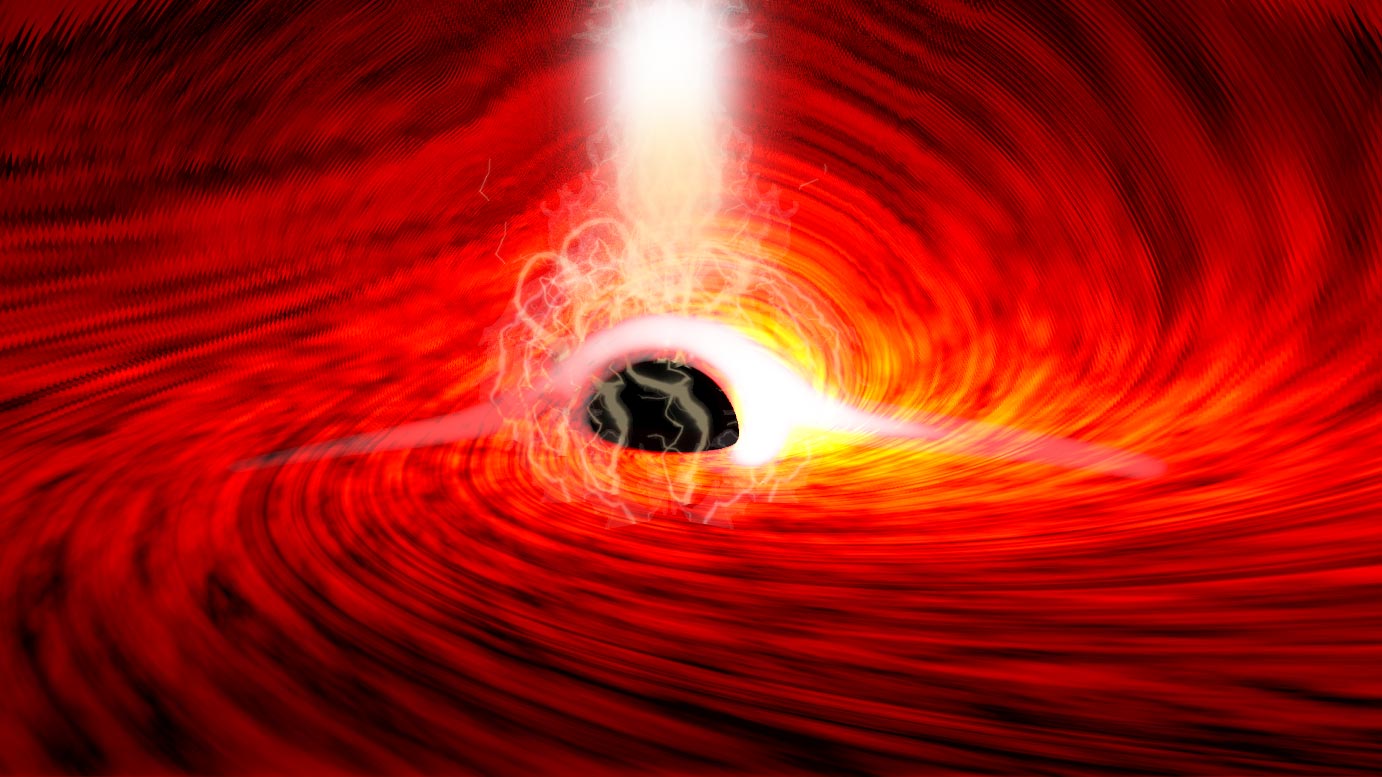
Watching X-rays flung out into the universe by the supermassive black hole
at the center of a galaxy 800 million light-years away, Stanford University
astrophysicist Dan Wilkins noticed an intriguing pattern. He observed a
series of bright flares of X-rays - exciting, but not unprecedented - and
then, the telescopes recorded something unexpected: additional flashes of
X-rays that were smaller, later and of different “colors” than the bright
flares.
According to theory, these luminous echoes were consistent with X-rays
reflected from behind the black hole - but even a basic understanding of
black holes tells us that is a strange place for light to come from.
“Any light that goes into that black hole doesn’t come out, so we shouldn’t
be able to see anything that’s behind the black hole,” said Wilkins, who is
a research scientist at the Kavli Institute for Particle Astrophysics and
Cosmology at Stanford and SLAC National Accelerator Laboratory. It is
another strange characteristic of the black hole, however, that makes this
observation possible. “The reason we can see that is because that black hole
is warping space, bending light and twisting magnetic fields around itself,”
Wilkins explained.
The strange discovery, detailed in a paper published today (July 28, 2021)
in Nature, is the first direct observation of light from behind a black hole
- a scenario that was predicted by Einstein’s theory of general relativity
but never confirmed, until now.
“Fifty years ago, when astrophysicists starting speculating about how the
magnetic field might behave close to a black hole, they had no idea that one
day we might have the techniques to observe this directly and see Einstein’s
general theory of relativity in action,” said Roger Blandford, a co-author
of the paper who is the Luke Blossom Professor in the School of Humanities
and Sciences and Stanford and SLAC professor of physics and particle
physics.
How to see a black hole
The original motivation behind this research was to learn more about a
mysterious feature of certain black holes, called a corona. Material falling
into a supermassive black hole powers the brightest continuous sources of
light in the universe, and as it does so, forms a corona around the black
hole. This light - which is X-ray light - can be analyzed to map and
characterize a black hole.
The leading theory for what a corona is starts with gas sliding into the
black hole where it superheats to millions of degrees. At that temperature,
electrons separate from atoms, creating a magnetized plasma. Caught up in
the powerful spin of the black hole, the magnetic field arcs so high above
the black hole, and twirls about itself so much, that it eventually breaks
altogether - a situation so reminiscent of what happens around our own Sun
that it borrowed the name “corona.”
“This magnetic field getting tied up and then snapping close to the black
hole heats everything around it and produces these high energy electrons
that then go on to produce the X-rays,” said Wilkins.
As Wilkins took a closer look to investigate the origin of the flares, he
saw a series of smaller flashes. These, the researchers determined, are the
same X-ray flares but reflected from the back of the disk - a first glimpse
at the far side of a black hole.
“I’ve been building theoretical predictions of how these echoes appear to us
for a few years,” said Wilkins. “I’d already seen them in the theory I’ve
been developing, so once I saw them in the telescope observations, I could
figure out the connection.”
Future observations
The mission to characterize and understand coronas continues and will
require more observation. Part of that future will be the European Space
Agency’s X-ray observatory, Athena (Advanced Telescope for High-ENergy
Astrophysics). As a member of the lab of Steve Allen, professor of physics
at Stanford and of particle physics and astrophysics at SLAC, Wilkins is
helping to develop part of the Wide Field Imager detector for Athena.
“It’s got a much bigger mirror than we’ve ever had on an X-ray telescope and
it’s going to let us get higher resolution looks in much shorter observation
times,” said Wilkins. “So, the picture we are starting to get from the data
at the moment is going to become much clearer with these new observatories.”
Reference:
Wilkins, D.R., Gallo, L.C., Costantini, E. et al. Light bending and X-ray
echoes from behind a supermassive black hole. Nature 595, 657-660
(2021). DOI:
10.1038/s41586-021-03667-0
Tags:
Space & Astrophysics