
New research published in Nature has revealed the solution to Jupiter's
'energy crisis', which has puzzled astronomers for decades.
Space scientists at the University of Leicester worked with colleagues from
the Japanese Space Agency (JAXA), Boston University, NASA's Goddard Space
Flight Center and the National Institute of Information and Communications
Technology (NICT) to reveal the mechanism behind Jupiter's atmospheric
heating.
Now, using data from the Keck Observatory in Hawai'i, astronomers have
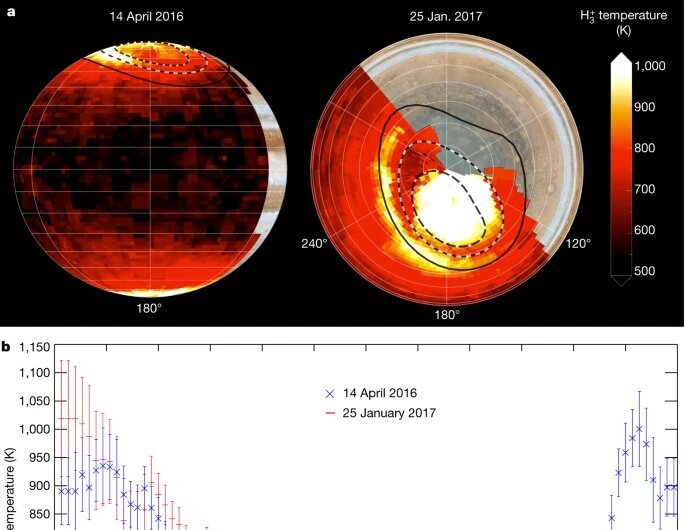
created the most-detailed yet global map of the gas giant's upper
atmosphere, confirming for the first time that Jupiter's powerful aurorae
are responsible for delivering planet-wide heating.
Dr. James O'Donoghue is a researcher at JAXA and completed his Ph.D. at
Leicester, and is lead author for the research paper. He said:
"We first began trying to create a global heat map of Jupiter's uppermost
atmosphere at the University of Leicester. The signal was not bright enough
to reveal anything outside of Jupiter's polar regions at the time, but with
the lessons learned from that work we managed to secure time on one of the
largest, most competitive telescopes on Earth some years later.
"Using the Keck telescope we produced temperature maps of extraordinary
detail. We found that temperatures start very high within the aurora, as
expected from previous work, but now we could observe that Jupiter's aurora,
despite taking up less than 10% of the area of the planet, appear to be
heating the whole thing.
"This research started in Leicester and carried on at Boston University and
NASA before ending at JAXA in Japan. Collaborators from each continent
working together made this study successful, combined with data from NASA's
Juno spacecraft in orbit around Jupiter and JAXA's Hisaki spacecraft, an
observatory in space."
Dr. Tom Stallard and Dr. Henrik Melin are both part of the School of Physics
and Astronomy at the University of Leicester. Dr. Stallard added:
"There has been a very long-standing puzzle in the thin atmosphere at the
top of every Giant Planet within our solar system. With every Jupiter space
mission, along with ground-based observations, over the past 50 years, we
have consistently measured the equatorial temperatures as being much too
hot.
"This 'energy crisis' has been a long standing issue—do the models fail to
properly model how heat flows from the aurora, or is there some other
unknown heat source near the equator?
"This paper describes how we have mapped this region in unprecedented detail
and have shown that, at Jupiter, the equatorial heating is directly
associated with auroral heating."
Aurorae occur when charged particles are caught in a planet's magnetic
field. These spiral along the field lines towards the planet's magnetic
poles, striking atoms and molecules in the atmosphere to release light and
energy.
On Earth, this leads to the characteristic light show that forms the Aurora
Borealis and Australis. At Jupiter, the material spewing from its volcanic
moon, Io, leads to the most powerful aurora in the Solar System and enormous
heating in the polar regions of the planet.
Although the Jovian aurorae have long been a prime candidate for heating the
planet's atmosphere, observations have previously been unable to confirm or
deny this until now.
Previous maps of the upper atmospheric temperature were formed using images
consisting of only several pixels. This is not enough resolution to see how
the temperature might be changed across the planet, providing few clues as
to the origin of the extra heat.
Researchers created five maps of the atmospheric temperature at different
spatial resolutions, with the highest resolution map showing an average
temperature measurement for squares two degrees longitude 'high' by two
degrees latitude 'wide'.
The team scoured more than 10,000 individual data points, only mapping
points with an uncertainty of less than five per cent.
Models of the atmospheres of gas giants suggest that they work like a giant
refrigerator, with heat energy drawn from the equator towards the pole, and
deposited in the lower atmosphere in these pole regions.
These new findings suggest that fast-changing aurorae may drive waves of
energy against this poleward flow, allowing heat to reach the equator.
Observations also showed a region of localized heating in the sub-auroral
region that could be interpreted as a limited wave of heat propagating
equatorward, which could be interpreted as evidence of the process driving
heat transfer.
Planetary research at the University of Leicester spans the breadth of
Jovian system, from the planet's magnetosphere and atmosphere, out to its
diverse collection of satellites.
Reference:
O'Donoghue, J. et al, Global upper-atmospheric heating on Jupiter by the
polar aurorae, Nature (2021).
DOI: 10.1038/s41586-021-03706-w
Tags:
Space & Astrophysics