
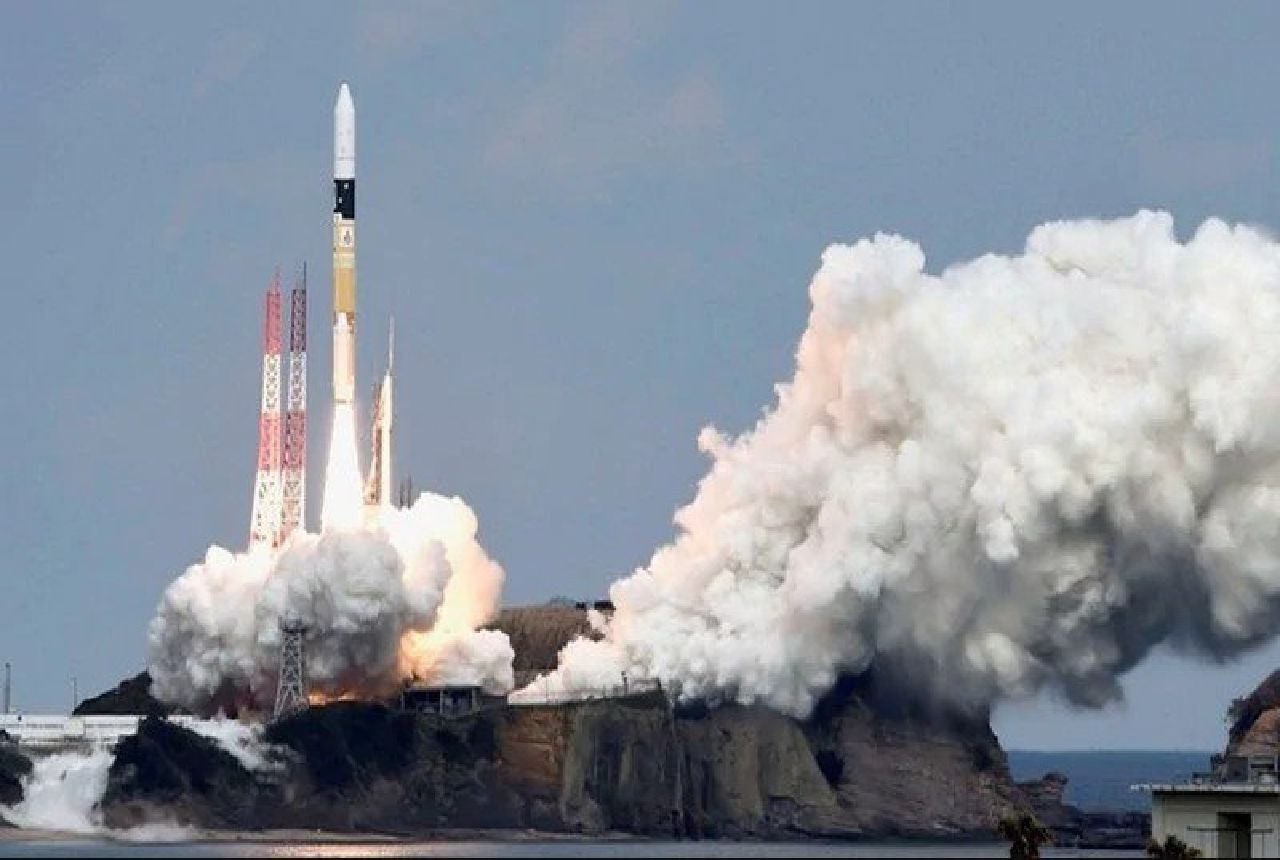
Japan's national space agency will work with nearly 30 Japanese companies
and institutions to develop reusable rockets with the goal of reducing
launch costs to less than a fourth of current levels, Nikkei has learned.
Mitsubishi Heavy Industries and ANA Holdings are included in the Japan
Aerospace Exploration Agency (JAXA) project, which aims for a maiden
reusable rocket launch by 2030. The move is designed to boost cost
competitiveness to the level of global market leader SpaceX, run by Tesla
chief executive Elon Musk.
Japan's main rockets, such as the H-IIA and the Epsilon, are not designed to
be recovered after launch. If part of a rocket can be reused, launch costs
significantly drop and orders for satellite launches from overseas are
expected to increase.
SpaceX is leading the way in developing reusable rockets. Rocket launches by
the company are estimated to cost about 6 billion yen ($52.9 million),
compared with the roughly 10 billion yen for an H-IIA rocket. SpaceX has
about a 60% share of the global commercial satellite launch market as of
2018.
Japan's Ministry of Education, Culture, Sports, Science and Technology,
which oversees JAXA, has said reusable rockets that launch satellites are
essential for the development of a next-generation system.
JAXA is expected to sign joint research contracts with about 30 companies
and organizations. Mitsubishi Heavy Industries, in cooperation with
logistics company NYK Line, will look into retrieval methods using drones
and ships. ANA will conduct research that applies its know-how in aircraft
operations and maintenance. NIPPI Corporation and GH Craft, a Teijin
subsidiary, will develop a gear system for landing.
Nagoya University will develop a vibration-resistant lithium-ion battery.
Canon IT Solutions, a subsidiary of Canon Marketing Japan, will use mixed
reality to streamline its manufacturing processes. Chiba Institute of
Technology will study low-cost small electric pumps while Kanazawa Institute
of Technology will study composite materials.
JAXA and partners plan to develop a prototype by 2026 and perform the first
launch test four years after that. By establishing reusable technology and
increasing the number of launches, they hope to reduce the cost to about 500
million yen by the early 2040s.
More than 24,800 satellites are expected to be launched globally between
2020 and 2030, according to U.S. research company Northern Sky Research. The
market, which includes the manufacture and launch of satellites, is likely
to grow by about 9% every year to more than $567 billion by 2030.
JAXA has been involved in the development of reusable technologies. Flight
tests of the small RV-X rocket are scheduled to happen before March, while
those of the CALLISTO rocket, which is closer to the practical stage in
cooperation with Europe, are scheduled in fiscal 2024.