
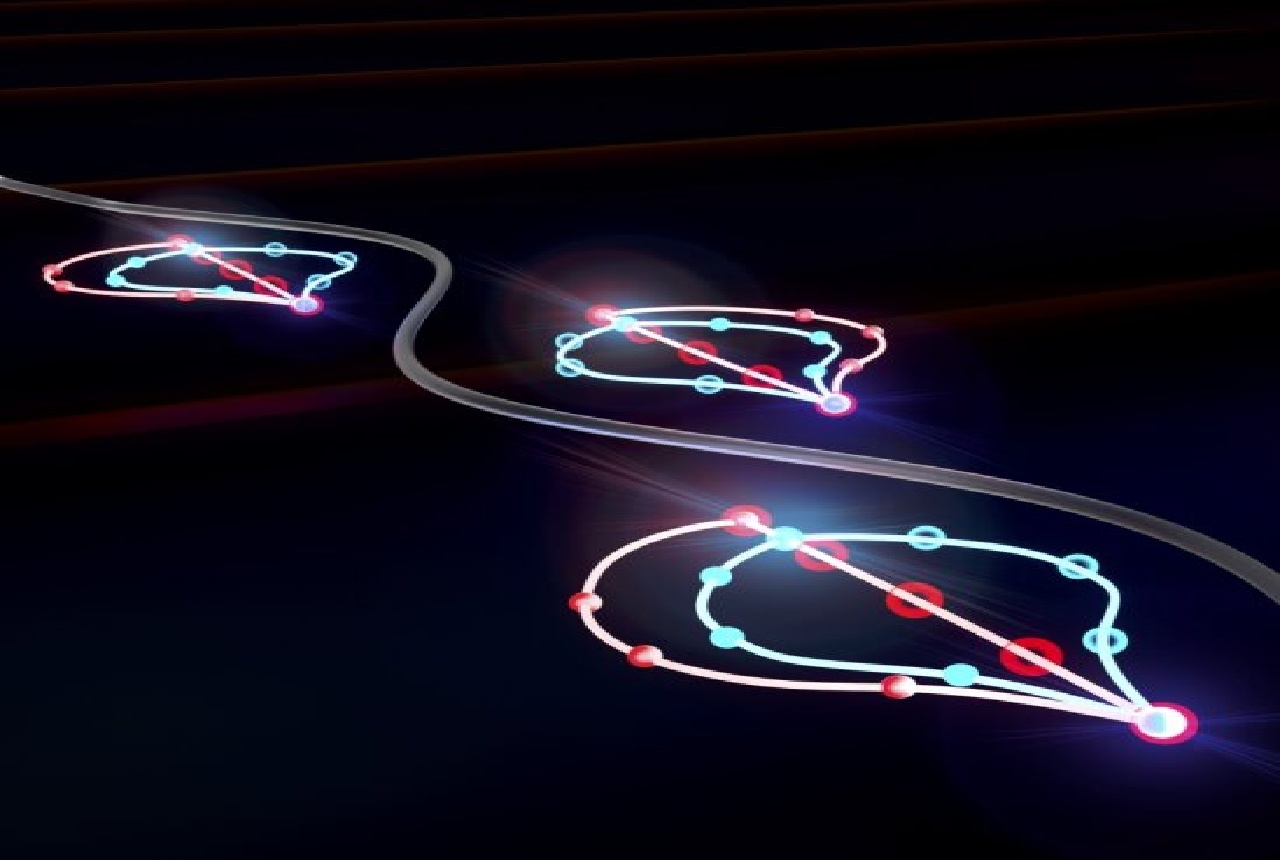
Lightspeed is the fastest velocity in the universe. Except when it isn't.
Anyone who's seen a prism split white light into a rainbow has witnessed how
material properties can influence the behavior of quantum objects: in this
case, the speed at which light propagates.
Electrons also behave differently in materials than they do in free space,
and understanding how is critical for scientists studying material
properties and engineers looking to develop new technologies. "An electron's
wave nature is very particular. And if you want to design devices in the
future that take advantage of this quantum mechanical nature, you need to
know those wavefunctions really well," explained co-author Joe Costello, a
UC Santa Barbara graduate student in condensed matter physics.
In a new paper, co-lead authors Costello, Seamus O'Hara and Qile Wu and
their collaborators developed a method to calculate this wave nature, called
a Bloch wavefunction, from physical measurements. "This is the first time
that there's been experimental reconstruction of a Bloch wavefunction," said
senior author Mark Sherwin, a professor of condensed matter physics at UC
Santa Barbara. The team's findings appear in the journal Nature, coming out
more than 90 years after Felix Bloch first described the behavior of
electrons in crystalline solids.
Like all matter, electrons can behave as particles and waves. Their
wave-like properties are described by mathematical objects called
wavefunctions. These functions have both real and imaginary components,
making them what mathematicians call "complex" functions. As such, the value
of an electron's Bloch wavefunction isn't directly measurable; however,
properties related to it can be directly observed.
Understanding Bloch wavefunctions is crucial to designing the devices
engineers have envisioned for the future, Sherwin said. The challenge has
been that, because of inevitable randomness in a material, the electrons get
bumped around and their wavefunctions scatter, as O'Hara explained. This
happens extremely quickly, on the order of a hundred femtoseconds (less than
one millionth of one millionth of a second). This has prevented researchers
from getting an accurate enough measurement of the electron's wavelike
properties in a material itself to reconstruct the Bloch wavefunction.
Fortunately, the Sherwin group was the right set of people, with the right
set of equipment, to tackle this challenge.
The researchers used a simple material, gallium arsenide, to conduct their
experiment. All of the electrons in the material are initially stuck in
bonds between Ga and As atoms. Using a low intensity, high frequency
infrared laser, they excited electrons in the material. This extra energy
frees some electrons from these bonds, making them more mobile. Each freed
electron leaves behind a positively charged "hole," a bit like a bubble in
water. In gallium arsenide, there are two kinds of holes, "heavy" holes and
"light" holes, which behave like particles with different masses, Sherwin
explained. This slight difference was critical later on.
All this time, a powerful terahertz laser was creating an oscillating
electric field within the material that could accelerate these newly
unfettered charges. If the mobile electrons and holes were created at the
right time, they would accelerate away from each other, slow, stop, then
speed toward each other and recombine. At this point, they would emit a
pulse of light, called a sideband, with a characteristic energy. This
sideband emission encoded information about the quantum wavefunctions
including their phases, or how offset the waves were from each other.
Because the light and heavy holes accelerated at different rates in the
terahertz laser field, their Bloch wavefunctions acquired different quantum
phases before they recombined with the electrons. As a result, their
wavefunctions interfered with each other to produce the final emission
measured by the apparatus. This interference also dictated the polarization
of the final sideband, which could be circular or elliptical even though the
polarization of both lasers was linear.
It's the polarization that connects the experimental data to the quantum
theory, which was expounded upon by postdoctoral researcher Qile Wu. Qile's
theory has only one free parameter, a real-valued number that connects the
theory to the experimental data. "So we have a very simple relation that
connects the fundamental quantum mechanical theory to the real-world
experiment," Wu said.
"Qile's parameter fully describes the Bloch wavefunctions of the hole we
create in the gallium arsenide," explained co-first author Seamus O'Hara, a
doctoral student in the Sherwin group. The team can acquire this by
measuring the sideband polarization and then reconstruct the wavefunctions,
which vary based on the angle at which the hole is propagating in the
crystal. "Qile's elegant theory connects the parameterized Bloch
wavefunctions to the type of light we should be observing experimentally."
"The reason the Bloch wavefunctions are important," Sherwin added, "is
because, for almost any calculation you want to do involving the holes, you
need to know the Bloch wavefunction."
Currently scientists and engineers have to rely on theories with many
poorly-known parameters. "So, if we can accurately reconstruct Bloch
wavefunctions in a variety of materials, then that will inform the design
and engineering of all kinds of useful and interesting things like laser,
detectors, and even some quantum computing architectures," Sherwin said.
This achievement is the result of over a decade of work, combined with a
motivated team and the right equipment. A meeting between Sherwin and Renbao
Liu, at the Chinese University of Hong Kong, at a conference in 2009
precipitated this research project. "It's not like we set out 10 years ago
to measure Bloch wavefunctions," he said; "the possibility emerged over the
course of the last decade."
Sherwin realized that the unique, building-sized UC Santa Barbara
Free-Electron Lasers could provide the strong terahertz electric fields
necessary to accelerate and collide electrons and holes, while at the same
time possessing a very precisely tunable frequency.
The team didn't initially understand their data, and it took a while to
recognize that the sideband polarization was the key to reconstructing the
wavefunctions. "We scratched our heads over that for a couple of years,"
said Sherwin, "and, with Qile's help, we eventually figured out that the
polarization was really telling us a lot."
Now that they've validated the measurement of Bloch wavefunctions in a
material they are familiar with, the team is eager to apply their technique
to novel materials and more exotic quasiparticles. "Our hope is that we get
some interest from groups with exciting new materials who want to learn more
about the Bloch wavefunction," Costello said.
Reference:
J. B. Costello et al, Reconstruction of Bloch wavefunctions of holes in a
semiconductor, Nature (2021).
DOI: 10.1038/s41586-021-03940-2
Tags:
Physics