
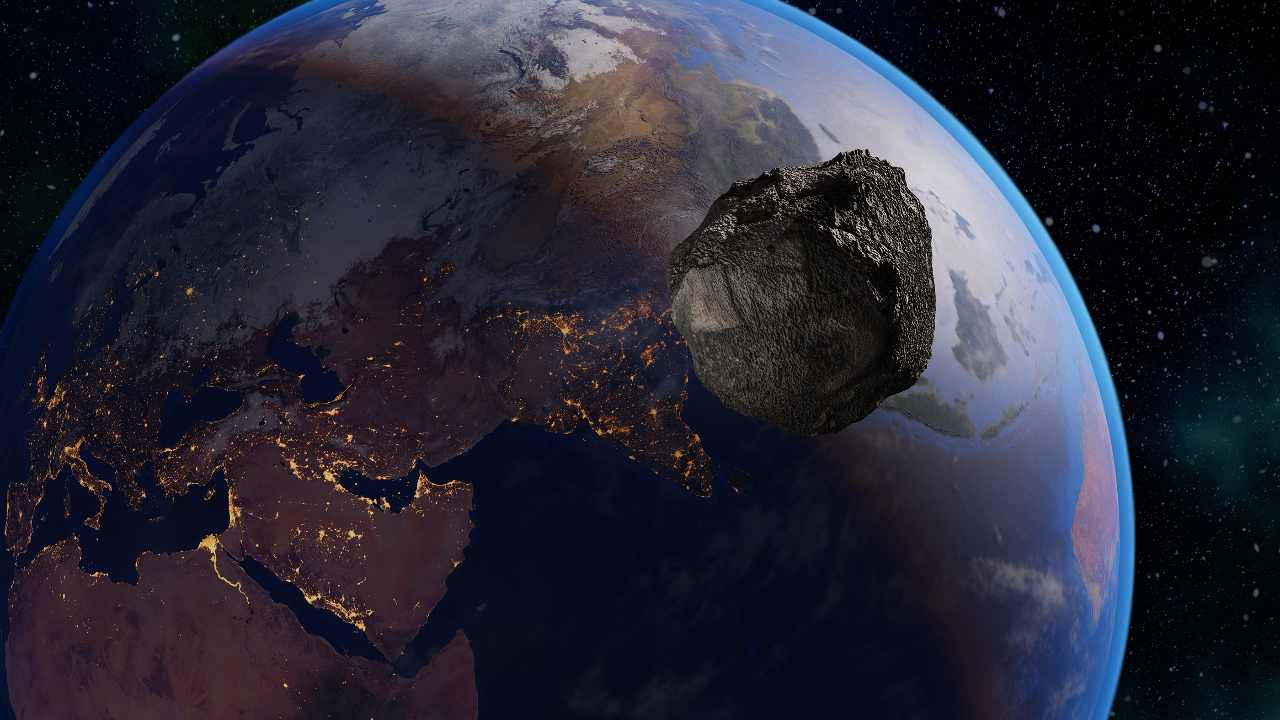
An asteroid wider than two football fields will zoom past Earth in the wee
hours of Thursday (Aug. 4). The asteroid is set to pass at 12:23 a.m. (ET).
NASA astronomers discovered the asteroid, known as 2022 OE2, just days ago,
on July 26. The meaty space rock is estimated to measure between 557 and
1,246 feet (170 to 380 meters) wide, which is about twice as wide as an
American football field is long. Astronomers also confirmed that 2022 OE2 is
an Apollo-class asteroid, which means it orbits the sun and crosses the path
of Earth's orbit, Live Science previously reported. (Astronomers know of
about 15,000 such asteroids.)
The impact from an asteroid this large would release more energy than 1,000
nuclear bombs. However, this one will miss Earth by a wide margin, according
to NASA's Jet Propulsion Laboratory.
Asteroid 2022 OE2 is predicted to pass Earth at a distance of roughly 3.2
million miles (5.1 million kilometers) — more than 13 times the average
distance between Earth and the moon. For context, this is significantly
farther than the asteroid 2022 NF, which came within a mere 56,000 miles
(90,000 km) — or about 23% the average distance between Earth and the moon —
on July 7.
NASA monitors tens of thousands of near-Earth objects like this one and has
estimated the trajectories of all of them beyond the end of the century. The
good news is, Earth is in no danger of a cataclysmic asteroid impact for at
least the next 100 years, NASA has said.
Still, astronomers are aware that a minor change in trajectory — which could
be caused by a collision with another asteroid, for example, or the
gravitational pull of a planet — could alter the orbit of a large asteroid
and put it on a potentially catastrophic course with Earth.
As such, space agencies take planetary defense very seriously. In November
2021, NASA launched an asteroid-deflecting mission called the Double
Asteroid Redirection Test, in which a spacecraft will slam directly into the
525-foot-wide (160 m) asteroid Dimorphos in autumn 2022. The collision won't
destroy the asteroid, but it may change the space rock's orbital path
slightly, Live Science previously reported. The mission will help test the
viability of asteroid deflection, should some future space rock pose an
imminent danger to our planet.
Originally published on
Live Science.
Tags:
Space & Astrophysics