
|
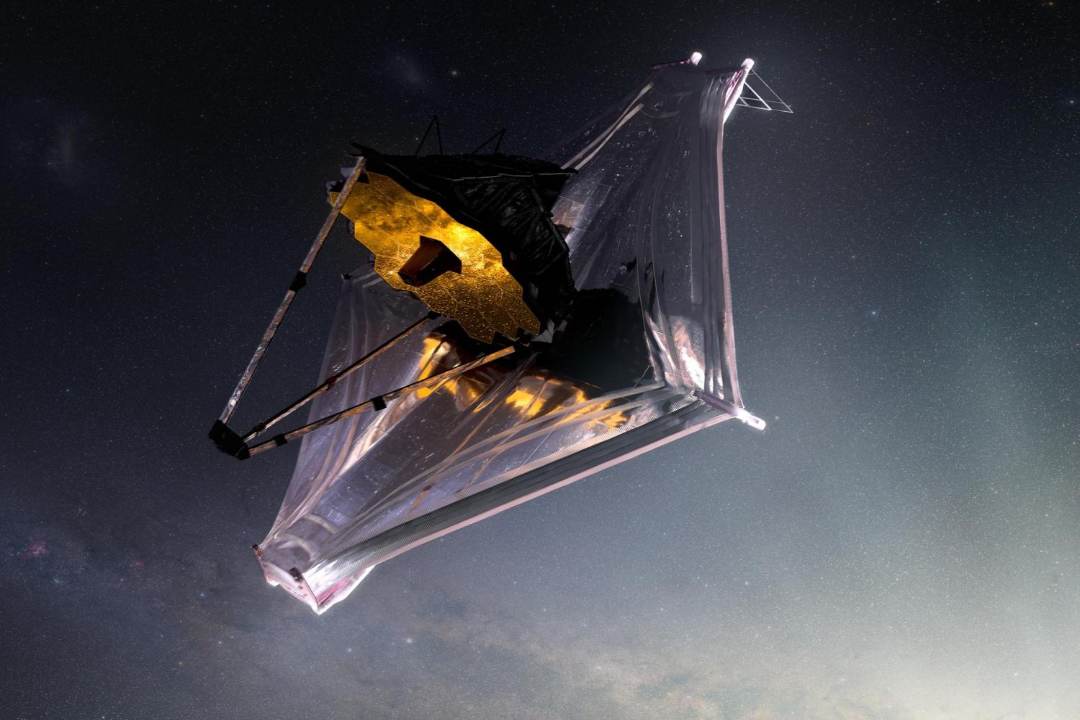
| Artist's depiction of the James Webb Space Telescope. (Credit: NASA GSFC/CIL/Adriana Manrique Gutierrez) |
Astronomers have identified what appear to be six massive galaxies from the
infancy of the universe. The objects are so massive, that if confirmed, they
could change how we think of the origins of galaxies.
The findings, published Wednesday in
Nature, use data from the James Webb Space Telescope’s infrared-sensing
instruments to picture what the universe looked like 13.5 billion years
ago—a time when it was just 3 percent of its current age.
Just 500 to 700 million years after the big bang, the potential galaxies
were somehow as mature as our 13-billion-year-old Milky Way galaxy is now.
The mass of stars within each of these objects totals to several billion
times larger than that of our sun, according to the research. One of them in
particular might be as much as 100 billion times our sun’s mass. For
comparison, the Milky Way contains a mass of stars equivalent to roughly 60
billion suns.
“You shouldn’t have had time to make things that have as many stars as the
Milky Way that fast,” says
Erica Nelson, an astrophysicist at the University of Colorado Boulder and a co-author
of the study to Lisa Grossman of
Science News. “It’s just crazy that these things seem to exist.”
Researchers expected to find only very small, young galaxies this early in
the universe’s existence. How these “monsters” were able to “fast-track to
maturity” is unknown, says Ivo Labbé, an astrophysicist at Swinburne
University of Technology in Australia and the study’s lead researcher, in an
email to Marcia Dunn of the
Associated Press.
|
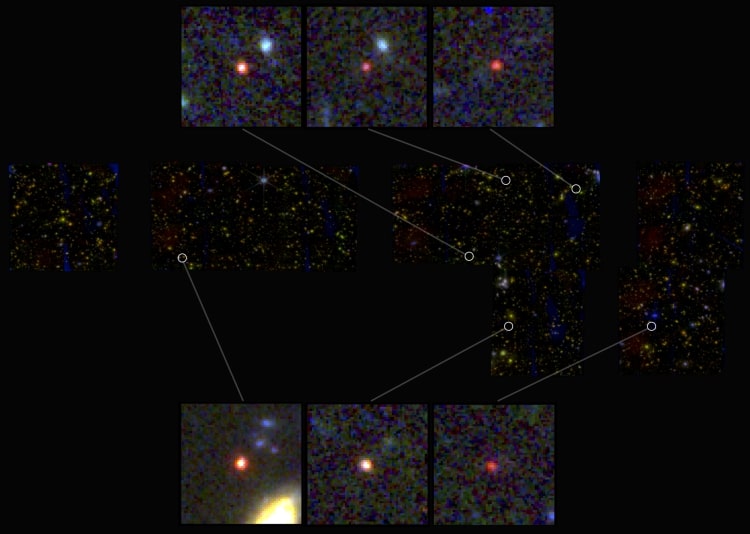
| A mosaic collected by James Webb of a region of space close to the Big Dipper, with insets showing the location of six new candidate galaxies from the dawn of the universe. Credits: NASA, ESA, CSA, I. Labbe (Swinburne University of Technology). Image processing: G. Brammer (Niels Bohr Institute’s Cosmic Dawn Center at the University of Copenhagen). |
According to most theories of cosmology, galaxies formed from small clouds
of stars and dust that gradually increased in size. In the early universe,
the story goes, matter came together slowly. But that doesn’t account for
the massive size of the newly identified objects.
“The revelation that massive galaxy formation began extremely early in the
history of the universe upends what many of us had thought was settled
science,” says Joel Leja, an astronomer and astrophysicist at Penn State and
a co-author of the study, in a
statement. “We’ve been informally calling these objects ‘universe breakers’—and they
have been living up to their name so far.”
Emma Chapman, an astrophysicist at the University of Nottingham in England
who was not involved in the research, tells the
Guardian’s
Hannah Devlin that these findings, if confirmed, could change how we
conceive of the early universe. “The discovery of such massive galaxies so
soon after the big bang suggests that the dark ages may not have been so
dark after all, and that the universe may have been awash with star
formation far earlier than we thought,” she tells the publication.
Still, it might not be time to rewrite cosmology just yet: The researchers
say it’s possible some of the objects could be obscured supermassive black
holes, and that what appears to be starlight in the images could actually be
gas and dust getting pulled in by their gravity.
“The formation and growth of black holes at these early times is really not
well understood,”
Emma Curtis-Lake, an astronomer at the University of Hertfordshire in England who was not
part of the study, explains to Science News. “There’s not a tension with
cosmology there, just new physics to be understood of how they can form and
grow, and we just never had the data before.”
To verify their findings, the researchers could take a spectrum image of the
objects they’ve pinpointed. This would help reveal how old they are.
Galaxies from the early universe appear to us as very “redshifted”—meaning
the light they emitted has been stretched out on its long journey to Earth.
The higher the redshift value, the more the light has been stretched and the
more distant and aged the galaxy is. With spectroscopy, scientists could
determine whether their potential galaxies, or “high-redshift candidates,”
are as old as they appear, or if they are just “intrinsically reddened
galaxies” from a more recent time, says Ethan Siegel, a theoretical
astrophysicist who was not involved in the study, to
CNET’s
Eric Mack.
While Leja agrees that more observations are needed to confirm the findings,
he notes in the statement, “Regardless, the amount of mass we discovered
means that the known mass in stars at this period of our universe is up to
100 times greater than we had previously thought. Even if we cut the sample
in half, this is still an astounding change.”
Source: Smithsonian Mag
Tags:
Space & Astrophysics